 My first year as a Public Director on the AIA Board was much like my first year of medical school, an avalanche of lexicon and acronyms, new procedures and odd politics. I learned much about leadership in architecture and noted similarities between our professions. We both strive to wed the conceptual world with the physical. In medicine, we commonly see bodies worn out by age, bad luck, or misuse. Some of our biggest challenges are in helping patients to decide among hard and humanly costly decisions—surgery, radiation, chemo, death. Sometimes we care for those who are well and focus strongly on prevention; in fact, I am a pediatrician who spent my career in preventive medicine. What are the options we can offer to maximize well-being, like immunization, and how do we minimize threats, like obesity and smoking? Many architects have similar experiences. The architects I admire most are the ones who turn a difficult site or a bad structure into a vital building with firmitas, utilitas, and venustas—as Vitruvius would demand—with smart use of energy and local resources, and with durability.
Physicians and architects are under similar demands. We must consider how to be socially responsible while completing our work on time, within budget. When physicians look for own doctors, we demand technical competence first, but then we want humility and humanity; I suspect that architects have similar thoughts on their own leaders. From what I have seen, you admire colleagues with great technical knowledge and creativity, with practical idealism and humanity. In fact, the most enjoyable part of being on the AIA Board was participating in the evaluation of the Gold Medal contenders— I was impressed how often the candidate’s fundamental character was discussed.
Over the last ten years, I have dedicated myself to the work of changing and improving the built environment, not only to improve health, but to enhance and preserve human and planetary well-being. I have been honored by the willingness and energy of architectural leaders to extend their view of the health and safety part of the profession. In 2003, I was invited to speak at the AIA Grassroots meeting in Washington about health and design. Near the end, I asserted to a room of 600 architectural leaders: “We need architects to design buildings with welcoming and beautiful stairways, put the elevators a bit out of the way! Walking up one flight of stairs a day for a year burns off calories equal to one pound of fat.” I worried that a leader would come up to me and say, “Doc, you don’t know anything about architecture.” But instead, the President of the AIA came up and said, “Thank you, we love stairways, they give us many more design options.”
Over the last ten years, we have witnessed a doubling of chronic diseases like obesity and diabetes and increasing rates of depression. Our nation will need to meet the needs of 10,000 boomers retiring each day. Our built environments must focus not only on energy and resource efficiency, but on health, on walkability, on daylighting, on wayfinding, on building community and mutual support. I have been so fortunate to work with AIA leaders who work not just in design, but on the well being of our communities and of us all. This has been the great gift to me in serving on the AIA Board.
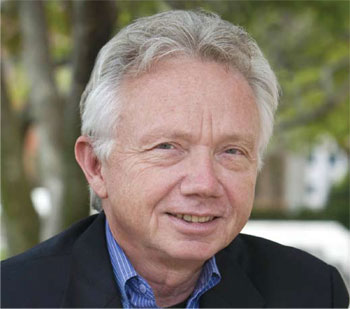
Richard J. Jackson, MD, MPH, FAAP, is Professor and Chair of Environmental Health Sciences at the School of Public Health at the University of California, Los Angeles. He served in many leadership positions in both environmental health and infectious disease with the California Health Department, including the highest, State Health Officer. For nine years he was Director of the CDC’s National Center for Environmental Health in Atlanta. Dr. Jackson served as an AIA Public Director, 2005-2007.
Originally published 1st quarter 2011, in arcCA 11.1, “Valuing the AIA.”