 Pasadena Glen Residence. Architect: Randolph Ruiz. Structural Engineer: Alexander Piper. Photography: Erich Koyama.
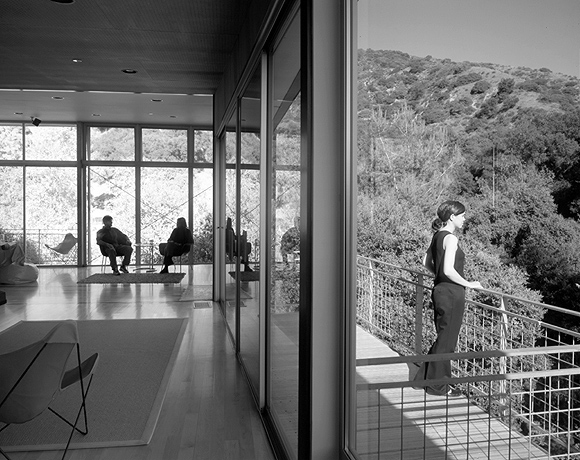
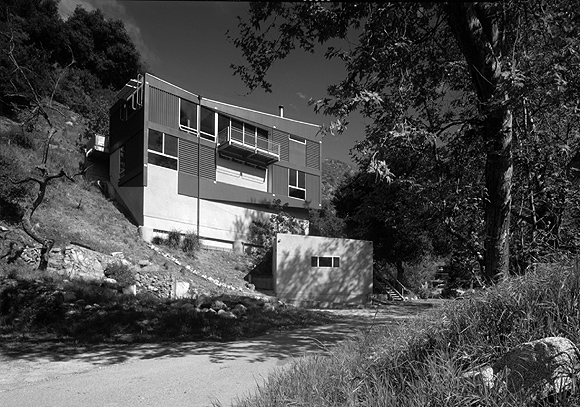
It is rare, in Southern California especially, to stumble upon a piece of modern architecture and actually be surprised. It’s everywhere. There are the buildings we know and the buildings that mimic the buildings we know. We’ve come to expect modernism in our cities and scattered through our “better” neighborhoods. It is just as rare, however, to find modern architecture in a semi-rural, middle class setting such as this. Does it not reach these places, or is it just out of reach? In Pasadena Glen, in the foothills of the San Gabriel Mountains, Randolph Ruiz manages to surprise us, and pleasantly so. Set on a steep site, at the edge of a seemingly benign creek, amongst the dangerously dry oak and laurel sumac, Ruiz has skillfully sited a highly articulated yet refreshingly modest, three-bedroom home, one that also happens to pack a heavy architectural punch. Like a hunter’s jacket seen through the trees, the project at once seems utterly out of place and yet somehow perfectly at home; out of place because you don’t expect it and at home because of its assertive though vulnerable posture. Unlike pure modernism, this is not an architecture of idealism or perfection. It’s an architecture of chance, reality, and awareness set in a location wrought with environmental hazards.
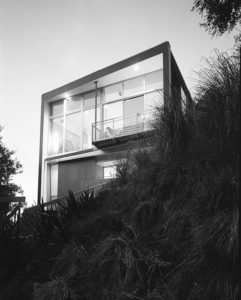 Ruiz’s agitated box is far from the prefect white “machine” of modernism, and, though Pasadena Glen is quite beautiful, Mother Nature’s ever-present threat of destruction prevents it from becoming any kind of paradise. In spite of this, the project is still very much the machine in the garden. It’s just that, where this project is concerned, the garden is planet earth or, more specifically, Southern California, where anything can happen at any moment. This particular machine is enabled with a heavy dose of awareness, modernism with a reality check.
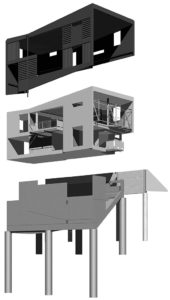 Ruiz is nothing if not real about the very serious threats, requirements, and constraints set upon this project. The project’s modest budget called for the clever and inventive use of materials. In order to control both raw material and labor costs, Ruiz employed a sort of off-the-shelf, Home Depot pragmatism. His use of materials that are architecturally unusual and technically appropriate, yet inexpensive, easily fabricated, and commonly used, helped to keep the project budget lean. He uses a robust but inexpensive, corrugated, cementitious panel as a siding material. It not only contributes significantly to the bold architectural expression and helps him to attain the necessary fire protection, but does it within a system that common construction laborers have mastered.
It is this combination of real world pragmatism, a sophisticated composition of form, pattern, material and texture, and an attitude about making a place in this precarious landscape that makes this project unusually interesting. Somehow, the project both respects and defies its natural setting. It seems to stand up proud in order to be heard, yet is savvy enough to watch its back. The project’s assertive but guarded stance represents our own relationship to nature. Although we’re part of it, we are continually on the alert and at times have no choice but to protect ourselves from it. This dichotomy seems especially apparent here in California. As we nibble away at the natural landscape, parcel by parcel, every now and then Mother Nature bites back. Because we continue to build in this frequently unstable and sometimes violent geo-climatic environment, it’s refreshing to see an architecture that engages the land in this tug of war, eye to eye. It is this very tension that makes for such a striking relationship between Ruiz’s bold, manmade object and the equally bold site on which it sits.
Author Benjamin Parco, AIA, is an associate at Skidmore, Owings & Merrill, San Francisco.
Originally published 1st quarter 2005, in arcCA 05.1, “Good Counsel.”